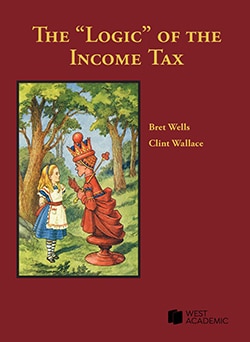
Wells and Wallace's The "Logic" of the Income Tax
Access to digital products is available immediately after completing your purchase. Please visit eproducts.westacademic.com and sign in.
eBook - Digital access to the eBook, with the ability to highlight and take notes.Description
The purpose of this book is to aid the reader in understanding the federal income tax. The income tax, on first inspection, can appear inscrutable, leaving one dazed and confused. The title, The “Logic” of the Income Tax, asserts that there is an underlying logic at the core of the income tax laws that connects all variety of technical income tax rules: every rule in the Tax Code can be explained by either the internal logic of the income tax (discussed in Part I) or the political economy of the income tax (discussed in Part II) or a combination of both.
The internal logic approaches income as a temporal concept. Income should be taxed once (and only once), it must be measurable in the time period in which it is included and subject to tax, and it must be tracked over time. Although the internal logic explains much of the structure of the federal income tax, it is also rife with anomalies that violate its internal logic and thus allow income to escape taxation partially or in its entirety over time. This logic explains many of the key features of the income tax: timing conventions for inclusions and deductions, including those related to compensation, loan proceeds, and proceeds from purchases of property, as well as basis rules that track these inclusions and deductions across time period. Looking beyond the internal logic to the broader political economy, the book explores how various deviations from the internal logic have come to exist, and asks how might these deviations be explained and justified as a matter of public policy. These deviations include realization, characterization of gains and losses from property transactions, nonrecognition provisions, and a variety of special deductions and exclusions. The book explores the context that produces these deviations: income tax laws are enacted through a dynamic political system that reflects the power structure of society and responds to changing social priorities refracted through purportedly democratic decision-making structures. It is in the midst of the political economy of the income tax where income tax laws are forged in ways that at times can diverge from the internal logic of the income tax.
Although Congress at times has repudiated the internal logic of the income tax, those purposeful deviations have generally been targeted to specific policy concerns. Seen in the broader context, Congress has largely attempted to adopt logical income tax laws, except where Congress has explicitly stated otherwise—or, in some instances, a deviation may be a tax mistake. A helpful feature to us in the study of the income tax is that Federal tax laws are written by tax specialists for tax specialists. Through the careful construction of statutory rules and accompanying legislative history, Congress and its staff can and mostly do make it clear when it intends to deviate away from the internal logic of the income tax in service of some other policy goal, which helps to reveal which deviations need fixing. This book explains the income tax and addresses these tensions and how the tax laws have navigated these tensions over time. For students, lawyers and judges using this book as a reference, understanding the income tax through the internal logic and political economy framework clarifies how and why the income tax works and doesn’t work today.
The internal logic approaches income as a temporal concept. Income should be taxed once (and only once), it must be measurable in the time period in which it is included and subject to tax, and it must be tracked over time. Although the internal logic explains much of the structure of the federal income tax, it is also rife with anomalies that violate its internal logic and thus allow income to escape taxation partially or in its entirety over time. This logic explains many of the key features of the income tax: timing conventions for inclusions and deductions, including those related to compensation, loan proceeds, and proceeds from purchases of property, as well as basis rules that track these inclusions and deductions across time period. Looking beyond the internal logic to the broader political economy, the book explores how various deviations from the internal logic have come to exist, and asks how might these deviations be explained and justified as a matter of public policy. These deviations include realization, characterization of gains and losses from property transactions, nonrecognition provisions, and a variety of special deductions and exclusions. The book explores the context that produces these deviations: income tax laws are enacted through a dynamic political system that reflects the power structure of society and responds to changing social priorities refracted through purportedly democratic decision-making structures. It is in the midst of the political economy of the income tax where income tax laws are forged in ways that at times can diverge from the internal logic of the income tax.
Although Congress at times has repudiated the internal logic of the income tax, those purposeful deviations have generally been targeted to specific policy concerns. Seen in the broader context, Congress has largely attempted to adopt logical income tax laws, except where Congress has explicitly stated otherwise—or, in some instances, a deviation may be a tax mistake. A helpful feature to us in the study of the income tax is that Federal tax laws are written by tax specialists for tax specialists. Through the careful construction of statutory rules and accompanying legislative history, Congress and its staff can and mostly do make it clear when it intends to deviate away from the internal logic of the income tax in service of some other policy goal, which helps to reveal which deviations need fixing. This book explains the income tax and addresses these tensions and how the tax laws have navigated these tensions over time. For students, lawyers and judges using this book as a reference, understanding the income tax through the internal logic and political economy framework clarifies how and why the income tax works and doesn’t work today.