Scott, Weithorn, Gupta-Kagan, and Davis's Children in the Legal System, 7th
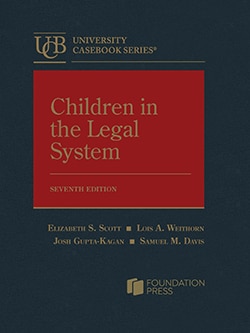
Hardbound - New, hardbound print book.  Included with
your purchaseFREE 14-day digital access to this book immediately after purchase. Sign in required.
Included withyour purchaseFREE 14-day digital access to this book immediately after purchase. Sign in required.
Description
The Seventh Edition has been thoroughly updated with the latest cases, statutory references, and scholarly commentary. Moreover, it includes comprehensive references to provisions of the American Law Institute’s Restatement of Children and the Law, which was adopted in 2024. The Seventh Edition of this casebook retains the basic overall organizational structure of the previous edition, while refining and updating the materials to reflect the field’s evolution. It incorporates discussion of important empirical findings relevant to its content from developmental neuroscience, psychology, and other branches of the behavioral and social sciences.
Since the publication of the Sixth Edition, the Supreme Court has decided several significant cases affecting the law’s treatment of children, some of which have dramatically reshaped the law. The Seventh Edition analyzes these new cases and their impact on the law regulating children and families, including:
This book is distinguished by its breadth of coverage, permitting a significant degree of flexibility for instructors. The book covers all of the key dimensions of the law’s regulation of and relationships with minors. Its subject matter ranges from foundational topics, such as the allocation of authority for decisions about children’s lives among parents, the state, and the children themselves, to the legal issues relevant to the many contexts in which the law touches children’s lives. It addresses health care decisions for and by minors; application of private law doctrines to minors (such as torts and contracts); free exercise, free expression, due process, and corporal punishment in school and other school-related issues; the youth justice system and the application of criminal justice principles to minors; abuse and neglect (including medical neglect), foster care, termination of parental rights and child welfare system policies. In light of this breadth of coverage, the book lends itself to use in any number of courses that might be styled “Youth Justice,” “Youth and Family Law,” “Parents, Children, and the Law,” or, indeed, “Children in the Legal System” or “Children and the Law.”
The broad range of material also lends itself to varying numbers of credit hours. The book contains a unique blend of cases, statutory materials, and scholarly commentary, including those from the social sciences in addition to law, in such a way that the teacher can draw on a number of sources in examining and teaching about any subject area covered in the book. No supplementary materials are needed; everything is in one book.
The organization of the book is an important pedagogical tool as well. It is organized to flow from one area to the next as it explores the overall relationship between the state, parents, and the child, understanding, of course, that a professor in a given course might choose to skip over some parts of the material in the interest of time and coverage.
Periodic electronic updates may be furnished to teachers, highlighting recent developments and cases, particularly decisions by the U.S. Supreme Court.
Since the publication of the Sixth Edition, the Supreme Court has decided several significant cases affecting the law’s treatment of children, some of which have dramatically reshaped the law. The Seventh Edition analyzes these new cases and their impact on the law regulating children and families, including:
- Dobbs v. Jackson Women’s Health Organization (2022), in which the U.S. Supreme Court reversed Roe v. Wade and Planned Parenthood v. Casey, holding that the U.S. Constitution does not protect the right to abortion. Although Dobbs did not focus on minors directly, the opinion has transformed the contours of minors’ reproductive rights, which are now defined by state constitutional and statutory law.
- United States v. Skrmetti (2025), in which the Court rejected an Equal Protection Clause challenge, holding that states may prohibit the provision of gender-affirming medical care to children, upholding one such provision;
- Mahmoud v. Taylor (2025), in which the Court held that the First and Fourteenth Amendments require public schools to offer parents of school children an “opt-out” or excusal from lessons that are viewed as interfering with the parents’ religious upbringing of their children;
- Kennedy v. Bremerton School District (2022), in which the Court held that a football coach had the right to engage in private prayer on the 50-yard line after school games, expanding Free Exercise rights in public schools, and limiting Establishment Clause restrictions in that setting;
- Fulton v. City of Philadelphia (2021), in which the Court held that the City of Philadelphia’s application of a policy prohibiting it from contracting with agencies that discriminate against certain groups or individuals in selecting foster parents violated the First Amendment rights of Catholic Social Services, which asserted that its refusal to certify same-sex couple as foster parents was an expression of its religious views.
This book is distinguished by its breadth of coverage, permitting a significant degree of flexibility for instructors. The book covers all of the key dimensions of the law’s regulation of and relationships with minors. Its subject matter ranges from foundational topics, such as the allocation of authority for decisions about children’s lives among parents, the state, and the children themselves, to the legal issues relevant to the many contexts in which the law touches children’s lives. It addresses health care decisions for and by minors; application of private law doctrines to minors (such as torts and contracts); free exercise, free expression, due process, and corporal punishment in school and other school-related issues; the youth justice system and the application of criminal justice principles to minors; abuse and neglect (including medical neglect), foster care, termination of parental rights and child welfare system policies. In light of this breadth of coverage, the book lends itself to use in any number of courses that might be styled “Youth Justice,” “Youth and Family Law,” “Parents, Children, and the Law,” or, indeed, “Children in the Legal System” or “Children and the Law.”
The broad range of material also lends itself to varying numbers of credit hours. The book contains a unique blend of cases, statutory materials, and scholarly commentary, including those from the social sciences in addition to law, in such a way that the teacher can draw on a number of sources in examining and teaching about any subject area covered in the book. No supplementary materials are needed; everything is in one book.
The organization of the book is an important pedagogical tool as well. It is organized to flow from one area to the next as it explores the overall relationship between the state, parents, and the child, understanding, of course, that a professor in a given course might choose to skip over some parts of the material in the interest of time and coverage.
Periodic electronic updates may be furnished to teachers, highlighting recent developments and cases, particularly decisions by the U.S. Supreme Court.