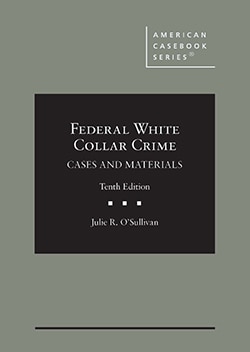
O'Sullivan's Federal White Collar Crime: Cases and Materials,10th
Access to digital products is available immediately after completing your purchase. Please visit eproducts.westacademic.com and sign in.
eBook - Digital access to the eBook, with the ability to highlight and take notes.Description
This casebook covers the theory and practice of domestic and transnational federal white-collar criminal investigations and prosecutions. It includes extensive coverage of the most commonly charged crimes including perjury; false statements; false claims; obstruction of justice; mail, wire, bank, and securities fraud; public corruption; insider trading; conspiracy; the Racketeer Influenced and Corrupt Organizations Act (RICO); and money laundering. Chapters focus on essential issues of mens rea, entity liability, and individual and organizational sentencing. The casebook also tackles procedural issues critical to white-collar practice, such as grand jury, discovery, the attorney-client privilege, Fifth Amendment issues, parallel proceedings, and more. Given the increasingly transnational nature of the practice, a final chapter covers the extraterritorial application of white-collar statutes and issues raised by international internal investigations, evidence gathering abroad, and extradition.
Among other changes, the Tenth Edition addresses important decisions and changes in many areas, such as: Introduction: included discussion of the upheaval in the Trump Department of Justice and politicization of charging choices in the Trump Administration; Mens Rea: included discussion of President Trump’s Executive Order 14294 (“Fighting Overcriminalization in Federal Regulations”) and expanded discussion of statutory interpretation with an emphasis on textualist philosophy; Sentencing: substantially re-written to include discussion of the bar on use of acquitted conduct, the elimination of departures; and the amended (as of November 2026) relevant conduct rule and revamped grouping rule; Entity Liability: updated to respond to various changes in the Trump Administration’s policies, including changes in the Principles of Federal Prosecution of Business Organizations and inclusion of the new department-wide Corporate Enforcement and Voluntary Disclosure Policy; and updated the discussion of the Caremark cases; Perjury, False Statements, and False Claims: discussed the Trump Administration’s new policies on FCA enforcement and summarized the litigation surrounding the constitutionality of qui tam actions; Obstruction: substantially reworked the chapter for clarity, including adding a unified background section to explain the development of the federal code’s obstruction chapter, an edited Fischer v. United States, 603 U.S. 480 (2024), and notes regarding Fischer; Fraud: substantially rewrote to omit McNally v. United States, 483 U.S. 350 (1987) as dated and United States v. Regent Office Supply, 421 F.2d 1174 (2d Cir. 1970) as overruled; substituted Kousisis v. United States, 605 U.S. 114 (2025) and a discussion of the fraudulent inducement theory of fraud; Corruption: added discussion of the D.C. Circuit’s decision in United States v. Paitsel, 147 F.4th 1010 (D.C. Cir. 2025) regarding § 201(b)(1)(C) and summarized the Trump Administration’s moratorium and policy changes on the enforcement of the FCPA; Discovery: added notes on bills of particulars and the Supreme Court’s decision in Chatrie v. United States, 146 S.Ct. 2193 (2026); Plea Bargaining: added an edited United States v. Hunter, 46 S.Ct. 1702 (2026) and a note regarding Garza v. Idaho, 586 U.S. 232 (2018); Parallel Proceedings: consolidated and clarified discussion of the difficulties posed by too-close coordination between DOJ criminal and civil attorneys as well as government prosecutors and private counsel.
Among other changes, the Tenth Edition addresses important decisions and changes in many areas, such as: Introduction: included discussion of the upheaval in the Trump Department of Justice and politicization of charging choices in the Trump Administration; Mens Rea: included discussion of President Trump’s Executive Order 14294 (“Fighting Overcriminalization in Federal Regulations”) and expanded discussion of statutory interpretation with an emphasis on textualist philosophy; Sentencing: substantially re-written to include discussion of the bar on use of acquitted conduct, the elimination of departures; and the amended (as of November 2026) relevant conduct rule and revamped grouping rule; Entity Liability: updated to respond to various changes in the Trump Administration’s policies, including changes in the Principles of Federal Prosecution of Business Organizations and inclusion of the new department-wide Corporate Enforcement and Voluntary Disclosure Policy; and updated the discussion of the Caremark cases; Perjury, False Statements, and False Claims: discussed the Trump Administration’s new policies on FCA enforcement and summarized the litigation surrounding the constitutionality of qui tam actions; Obstruction: substantially reworked the chapter for clarity, including adding a unified background section to explain the development of the federal code’s obstruction chapter, an edited Fischer v. United States, 603 U.S. 480 (2024), and notes regarding Fischer; Fraud: substantially rewrote to omit McNally v. United States, 483 U.S. 350 (1987) as dated and United States v. Regent Office Supply, 421 F.2d 1174 (2d Cir. 1970) as overruled; substituted Kousisis v. United States, 605 U.S. 114 (2025) and a discussion of the fraudulent inducement theory of fraud; Corruption: added discussion of the D.C. Circuit’s decision in United States v. Paitsel, 147 F.4th 1010 (D.C. Cir. 2025) regarding § 201(b)(1)(C) and summarized the Trump Administration’s moratorium and policy changes on the enforcement of the FCPA; Discovery: added notes on bills of particulars and the Supreme Court’s decision in Chatrie v. United States, 146 S.Ct. 2193 (2026); Plea Bargaining: added an edited United States v. Hunter, 46 S.Ct. 1702 (2026) and a note regarding Garza v. Idaho, 586 U.S. 232 (2018); Parallel Proceedings: consolidated and clarified discussion of the difficulties posed by too-close coordination between DOJ criminal and civil attorneys as well as government prosecutors and private counsel.