Kaminski, Ohm, and Selbst's Artificial Intelligence Law
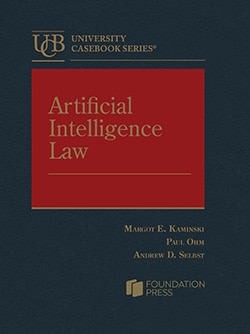
Hardbound - New, hardbound print book.
Description
This new casebook treats Artificial Intelligence systems as a fast-developing set of new technologies that put pressure on our social, economic, and legal systems and that may require the creation of new laws and approaches to laws. The book treats AI Law as sufficiently well-developed to justify a fully fleshed out casebook that can be used in doctrinal, lecture-style classes, with a final exam at the end. The book will be useful in seminar classes as well. The authors center every discussion around primary sources of laws—cases, statutes, and rules—and supplement these with secondary sources and notes and questions.
The book surveys developments in AI through five lenses: automated decisionmaking; laws addressing physical harms; issues relating to generative AI; privacy; and approaches for designing AI-specific law. Within these five major parts, the book touches on dozens of substantive legal topics, including (among many others) copyright, tort, product safety, product design regulation, First Amendment, Fourth Amendment, data protection, and consumer protection law. It devotes entire chapters to cross-cutting case studies including on facial recognition, recidivism-prediction algorithms, and deepfakes.
The book emphasizes the practice of AI Law, hoping this will be a useful reference text for practitioners and policymakers, in the U.S. and around the world. It also emphasizes the technical details, giving students and professors who use this book chapter-length primers that explain how the various technologies of AI (e.g. neural networks, decision trees, large language models) work. These primers try to strike the balance between overwhelming with unnecessary detail and giving the material only an insufficiently superficial gloss. Although it centers the federal and state law of the United States, it draws heavily into comparative examples and dives deeply into European Union Law, including the EU AI Act.