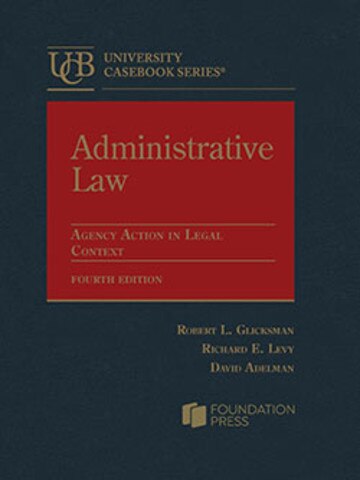
Glicksman, Levy, and Adelman's Administrative Law: Agency Action in Legal Context, 4th
Access to digital products is available immediately after completing your purchase. Please visit eproducts.westacademic.com and sign in.
CasebookPlus eBook – An eBook with the ability to highlight and take notes, plus 12 month access to a digital Learning Library that includes self-assessment quizzes, study aids, an outline starter, and more.Description
The authors of this innovative administrative law casebook, which now include David Adelman of the University of Texas Austin School of Law, prepared the fourth edition against the backdrop of rapid and profound change in administrative law. Producing the fourth edition has presented unique challenges, as decisions by federal courts and actions by the executive branch in recent years have undercut or raised fundamental questions about bedrock administrative law principles. The Supreme Court has dramatically reshaped administrative law’s foundations, most notably separation of powers principles and judicial review.
The fourth edition explores the implications of these and other recent developments and identifies unresolved or pending issues. It also reflects additional changes to enhance the book’s effectiveness as a teaching and learning tool, including new primary administrative law materials, improvements to problems, and principal cases that reflect the most recent Supreme Court precedent.
The new edition incorporates these developments while retaining and enhancing its unique features:
The book uses a consistent “unit” format throughout. Each unit covers a particular topic and includes (1) a comprehensive introduction to the basic doctrine governing the topic; (2) principal cases that illustrate the application of the doctrine and highlight key issues; (3) related matters sections that explore additional issues and connections between topics; and (4) a discussion problem that give students the opportunity to apply the unit’s doctrines in context. This unique structure facilitates use of the book with various teaching methods, including the Socratic method, lecture and discussion, and the problem method. The book is also an ideal tool for teachers who want to flip their classrooms. This unit structure also enhances the book’s flexibility, allowing teachers easily to select topics for coverage and determine the desirable depth.
The fourth edition explores the implications of these and other recent developments and identifies unresolved or pending issues. It also reflects additional changes to enhance the book’s effectiveness as a teaching and learning tool, including new primary administrative law materials, improvements to problems, and principal cases that reflect the most recent Supreme Court precedent.
The new edition incorporates these developments while retaining and enhancing its unique features:
- Focus on five representative agencies to provide students with a more holistic understanding of agencies and provide context.
- Use of a consistent unit design that maximizes student learning and facilitates the use of the book with a wide variety of teaching styles, including traditional methods and the “flipped” classroom.
- Incorporation of cutting-edge cases and problems, including primary agency materials, that emphasize the practical application of administrative law doctrines.
The book uses a consistent “unit” format throughout. Each unit covers a particular topic and includes (1) a comprehensive introduction to the basic doctrine governing the topic; (2) principal cases that illustrate the application of the doctrine and highlight key issues; (3) related matters sections that explore additional issues and connections between topics; and (4) a discussion problem that give students the opportunity to apply the unit’s doctrines in context. This unique structure facilitates use of the book with various teaching methods, including the Socratic method, lecture and discussion, and the problem method. The book is also an ideal tool for teachers who want to flip their classrooms. This unit structure also enhances the book’s flexibility, allowing teachers easily to select topics for coverage and determine the desirable depth.