EagleWoman's Native American Law: Tribal Nations and the United States Relations Cases and Materials
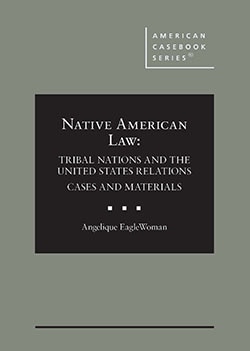
Hardbound - New, hardbound print book.  Included with
your purchaseFREE 14-day digital access to this book immediately after purchase. Sign in required.
Included withyour purchaseFREE 14-day digital access to this book immediately after purchase. Sign in required.
Description
This book incorporates a legal framework and chronology of the interaction and governance between Tribal Nations and the United States of America. On the assumption that the readers have minimal background on Tribal Nation legal principles and the relations with the United States, the author’s commentary puts judicial, statutory, and policy interpretations in historical context, including tensions in perspectives. This book employs a blend of legal, political, social movement, and economic relations in the study of these evolving relationships. The legal principles, governance, and diplomacy of Tribal Nations is the foundation for engaging in and understanding the experience of the U.S. Indian policy eras. Native American Law is brought into focus through examining multiple perspectives from the over 570 Tribal Nations in legal relations with the U.S. government. The text is deliberately designed to provide the bilateralism of the relations between governments and governance philosophies. Students are expected to be actively engaged in understanding the legal foundations of bilateral relations and the development from the founding of the U.S. throughout U.S. Indian policy eras to modern day.
Problems and exercises for deeper exploration of chapter topics are included that allow instructors to focus on selected Tribal Nations and jurisdictional issues. Student learning is facilitated through study of short and medium legal cases with greater length for foundational case decisions. The concept of legal pluralism is central to the field with legal cases and statutes focused on the extent and bounds of federal, state, and Tribal Nation jurisdictions. Both asynchronous and synchronous teaching modalities will find the material presented in an accessible and chronological order for key principles.
Problems and exercises for deeper exploration of chapter topics are included that allow instructors to focus on selected Tribal Nations and jurisdictional issues. Student learning is facilitated through study of short and medium legal cases with greater length for foundational case decisions. The concept of legal pluralism is central to the field with legal cases and statutes focused on the extent and bounds of federal, state, and Tribal Nation jurisdictions. Both asynchronous and synchronous teaching modalities will find the material presented in an accessible and chronological order for key principles.