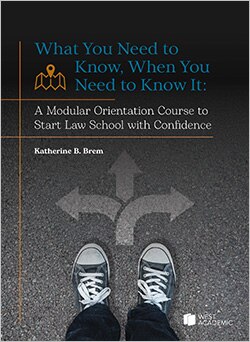
Brem's What You Need to Know, When You Need to Know It: A Modular Orientation Course to Start Law School with Confidence
Access to digital products is available immediately after completing your purchase. Please visit eproducts.westacademic.com and sign in.
Description
Starting law school can feel like stepping into another language. Orientation to Law School helps you decode it. In this short, interactive course, Professor Katherine Brem walks you through exactly what to expect—and how to succeed—from the first day of class. You’ll learn how to:
- Understand how the U.S. legal system is structured and where law comes from.
- Read and brief cases efficiently (without getting lost in the details).
- Recognize how professors use the Socratic method—and how to prepare for it.
- Analyze legal problems using the IRAC formula that every lawyer relies on.
- Approach outlining and exams strategically, with the law school curve in mind.
- Module 1 demystifies the law school classroom and the Socratic method by showing how professors use questioning to build analytical reasoning and active engagement. Students learn how legal education differs from undergraduate study and how to approach class discussions with confidence and purpose.
- Module 2 introduces the structure of the U.S. legal system and foundational legal vocabulary essential for the first week of law school. Students examine how cases move from trial to appeal, how to identify parties and issues, and how courts communicate their reasoning.
- Module 3 introduces students to the architecture of the American legal system and the process of legal reasoning. Students explore separation of powers, federalism, and the four primary sources of law before turning to the craft of critical reading and case briefing. Through active learning and guided debriefs, students participate in a mock class, identifying issues, holdings, and rules of law to map how doctrines evolve and applying those doctrines to a series of hypotheticals. The module concludes with practical strategies for engaging effectively in Socratic dialogue and anticipating how legal rules develop through precedent.
- Module 4 introduces IRAC—Issue, Rule, Application, Conclusion—as the universal formula for legal reasoning and writing. Through guided examples, students learn to apply IRAC to client problems and hypotheticals, preparing for class discussion, legal writing assignments, and exams.
- Module 5 synthesizes prior skills to prepare students for law school assessments. Students learn how to convert notes into course outlines, craft exam answers using IRAC, and understand grading on the law school curve, fostering confidence and strategic self-management.